
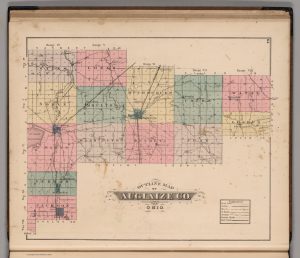
Townships of Auglaize County
| Township | Township | Township |
|---|---|---|
| Clay | Jackson | Pusheta |
| Duchouquet | Logan | Saint Marys |
| German | Moulton | Salem |
| Goshen | Noble | Union |
| Washington | Wayne |
If you would like to submit a Township History, please e-mail the Coordinator
Prehistoric Auglaize County
Bones of Mastodons were located three times in Auglaize County before 1880. The first skeleton was discovered in the fall of 1870 in Clay Township, 2 1/2 miles east of St. Johns while laborers were excavating a ditch through Muchinippi swamp. The swamp’s depth at this point was about eight feet, the upper third of peat moss, and the lower two thirds of marly clay. The bones were in a posture that indicated the mastodon was sinking in the swampy mire, the head and tusks were reaching upward and the right forefoot thrown forward as if to climb out of a hole. The body was estimated to be 19 1/2 feet long from where the tusks entered the cranium to the base of the tail, the length of the tusks were 12 feet, and its height was estimated to be 13 or 14 feet. In December, 1874, also in Clay Township, the partial skeleton of a larger Mastodon was found by another team of ditch diggers. A third Mastodon was found by Mr. Samuel Craig in January, 1878, while surveying in Washington Twp.
Before White Settlers Came:
The following is a portion of “An Historical Account of the Early Religious and Social Life of the New Knoxville, Ohio Community (1836-1900),” which was written by Edwin R. Kuck, a descendant of F.H.W. Kuckherman, Pastor of the German Evangelical Reformed Church (now the United Church of Christ) from 1843 to 1890. Reprinted here with permission. While there is no recorded evidence of any white man’s activity in the immediate area of the New Knoxville community prior to the year 1830, the nearby locations of St. Marys, Ohio, and Wapakoneta, Ohio, played a distinctive part in Indian life and in the early Indian frontier conquest.
Native American Tribes
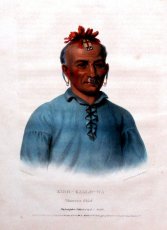
Originally the land now comprising Auglaize County was claimed principally by the Miami Tribe. Although hunting parties of the Wyandotte tribe would sometimes encroach upon the lands. However, when the Miami village of Pickawillamy (near Springfield, Ohio) was attacked by General George Rogers Clark and completely destroyed by fire in 1782, the tribe moved to the state of Indiana.
Almost as soon as the Miami tribe had moved, the strong Shawnee tribe which had been driven from the Carolina’s and Georgia moved in and possessed the land formerly occupied by the Miamis. Under the leadership of Chief Blue Jacket and Chief Black Hoof they established themselves at the mouth of the Auglaize River and built the famous Council House at the present site of Wapakoneta, Ohio. At this new location munitions of war were regularly supplied them by the British from Detroit and Canada.
At the Council House in the village of Wapakoneta, some of the most prominent leaders in Native American history assembled: Blue Jacket and his son, James Blue Jacket; Black Hoof; Tecumseh; The Prophet; Peter Cornstalk; The Little Turtle; The Little Snake; and the noted tribal interpreter, Francis Duchouquet; along with Captain Logan and others. Following the Treaty of Greenville, segments of the Shawnee and other affiliated tribes began migrating westward toward Missouri. The final migration, in accordance with treaty provisions, was completed in 1832 when James Blue Jacket—who had long maintained a flourishing trade in liquor—departed with the last group.
Because of the favored tribal portage between the St. Marys River to the north and Loramie Creek to the south, James Girty, one of three renegade brothers, established himself there in 1783 in what is now the site of St. Marys, Ohio, as a trader. The post soon became known as Girty’s Town. For a number of years, he enjoyed a practical monopoly of the trade with Native American tribes in the area, shipping his peltry down the St. Marys River to the Maumee.
With James Girty well established among the local tribes through his trading post, his brother Simon Girty soon saw the advantage and made it his chief base of operations. In American history, few names are more despised or associated with infamy and treachery than that of Simon Girty. He betrayed settlers, planned massacres, scouted for Native American war parties, and reportedly laughed during the torture of captured soldiers. He was never known to stake out a claim, build a cabin, or erect a wigwam. When General Anthony Wayne approached the St. Marys area in 1794, James Girty packed up his goods and fled to Canada, ending the notorious Girty Brothers’ chapter in Ohio history.
Between the years 1790 and 1794, fierce battles were fought by Native American confederacies to defend their homelands in the Ohio region. In 1790, General Harmar constructed a road to what is now Fort Wayne, Indiana, but his forces were decisively defeated by a coalition of tribal warriors. The following year, General St. Clair was dispatched by President Washington to suppress Native resistance that threatened frontier settlements in Pennsylvania, Kentucky, and across the Northwest Territory.
The journal of John Brickell, a captive of the Delaware from May 1781 to January 1795, recounts that the Native communities along the Auglaize River began preparing for St. Clair’s advance by sending women and children northward down the Maumee River. Approximately 1,000 Native warriors assembled—not under Little Turtle of the Miami, as often claimed, but under the renowned Mohawk leader, Joseph Brant, who brought 150 Mohawk fighters. Of the 1,400 soldiers in St. Clair’s army, 890 were killed, and the survivors retreated to Fort Jefferson, pursued only briefly by Native forces.
This devastating defeat led to the formation of a new, well-trained U.S. force known as “The Legion,” commanded by General Anthony Wayne. His eventual victory at the Battle of Fallen Timbers in 1794 resulted in the signing of the Treaty of Greenville in 1795, which redrew boundaries and ceded large portions of Ohio to the United States. When General Wayne arrived at the site known as Girty’s Town, he found the trading post abandoned but recognized its strategic location at the headwaters of the St. Marys River. He ordered a detachment to survey the area, and Fort St. Marys was constructed in 1795 under the command of Captain John Whistler.
During the War of 1812, Fort St. Marys became a key headquarters for General Harrison’s army and served as a major supply depot for military operations in northwestern Ohio. The volume of provisions—cattle, horses, and stores—necessitated additional buildings, including a stockade to protect livestock. A nearby spring, located where the Fort Barbee Hotel now stands, provided a reliable source of fresh water. Once completed, the depot was named Fort Barbee in honor of its commanding officer.
Such were the conditions during the pre-settlement era, when military operations played a vital role in securing the region for incoming settlers.
The county of Auglaize was established by the following act:
To Erect the County of Auglaize. SECTION 1.Be it enacted by the General Assembly of the State of Ohio, That such parts of the counties of Allen and Mercer as are included within the boundaries hereinafter described, be and the same are hereby erected into a separate and distinct county, which shall be known by the name of Auglaize, to wit: beginning at the northeast corner of Shelby county; thence west on the north line of Shelby county to the south-west corner of section thirty, in township number six, south, of range number five, east; thence south on the township line to the south-cast corner of section thirty-six, in township number seven, south, of range number four, east; thence west on the township line to the south-east cornei of section thirtyone, in said township; thence south on the section line to the Darke county line; thence westerly on said line to the southwest corner of section seven, in township number eight, south, of range number four, east; thence north on the township line to the north-west corner of section nineteen, in township number four, south, of range number four, east; thence cast on the section line to the north-cast corner of section thirty-four, in township number four, south, of range number five, east; thence south on the township Hue to the north-east corner of section thirty-six, in said township; thence east on the section line to the north-east corner of section thirty-six, in township number four, south, of range number six, east; thence south to the south-east corner of said section, thence cast on the township line to the north-east corner of section one. in township number five, south, of range number eight, east; thence south on the Hardin county line to the north line of Logan county; thence west on the Logan county line to the north-west corner of said Logan county; thence south on the Logan county line to the place of beginning. February 14, 1848 Auglaize county contains three hundred and ninety-four square miles, comprised in fourteen townships, as follows; Wayne, Moulton, and Logan twenty-seven. Union and St Marys thirty-six; Goshen and German eighteen; Pusheta, Noble. Washington, and Clay thirty’. Jackson twenty; Duchouquet forty-two; and Solcm twenty-four square miles. The general outline of the county is somewhat irregular, Its greatest length from east to west is about thirty-nine miles, and its width varies from seven and a half to twenty-three miles. It lies at the southern extremity of the region commonly known as the "Black Swamp." It is only the north-western portion of the county, however, that possesses the characteristics peculiar to that noted region. It is situated on the watershed sloping toward Lake Erie, except a small portion in the eastern and south-eastern sections, drained by the Scioto river.
From the past to the Space Age, our county has made history — thanks to our native son Neil Armstrong. The museum is dedicated to him and to the spirit of exploration and the achievements of a man whose journey began long before Apollo 11.
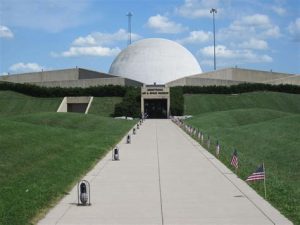
On July 20, 1969 the Apollo 11 crew had completed the greatest journey in human history, putting men on the moon and setting the course for the future of the nation’s space program. That day, Ohio Governor James Rhodes proposed a museum as a monument to the achievements of not only Armstrong but “all Ohioans who have attempted to defy gravity,” as well as to the history of the space program itself. On July 20, 1972, three years to the day after Neil Armstrong’s Walk on the moon, the Armstrong Air & Space Museum opened. It is one of the major sites for preserving this story and America’s rich heritage in space exploration.
The Armstrong Air & Space Museum is managed locally by the Armstrong Air & Space Museum Association and is accredited by the American Association of Museums. You can find more about the museum’s founding and evolution on: the Armstrong Museum’s official history page
Before his historic mission to the Moon, Neil was a naval aviator from 1949 to 1952, he flew 78 combat missions during the Korean action. He was a NASA test pilot pushing the limits of speed and altitude in the X‑15 rocket plane — a program that bridged the gap between atmospheric flight and space exploration, flying that experimental aircraft to more than 200,000 feet and approximately 4,000 miles per hour. What a love of flying and maybe speed?
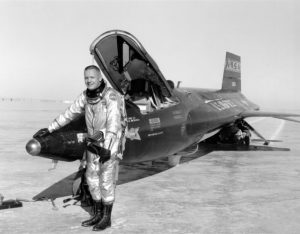

He was selected for NASA’s second astronaut group in 1962 — as a civilian unlike most of the Mercury Seven who were military officers. His first spaceflight was Gemini 8 in 1966, making him the first civilian astronaut to command a U.S. spacecraft. On that mission he performed the first successful docking of two vehicles in space. He later was backup command pilot for the Gemini 11 mission.
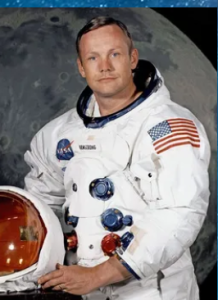
So, when Neil commanded Apollo 11 in 1969, he became not only the first person to walk on the Moon but as a civilian. The distinction was a big deal at the time, signaling NASA’s shift toward broader inclusion of scientists and engineers beyond just military pilots.
Armstrong repeatedly credited those behind the scenes for the moon landing’s success, as he did in a 2001 interview for NASA’S Johnson Space Center Oral History Project: “When you have hundreds of thousands of people all doing their job a little better than they have to, you get an improvement in performance. And that’s the only reason we could have pulled this whole thing off.”
Armstrong was one of the strongest boosters of scientific space exploration. He felt that space research would eventually eliminate human damage from natural devastations through an early warning system and would help take the guesswork out of much of our earthly toil.
Additional biographical details available on Neil’s bio page.