
Auglaize County Courthouse
Coordinator’s Note: As a native of Auglaize County, I was always fascinated by the courthouse. The youngster in me wondering what that huge building was about. What went on there, who were the people that worked there. etc. Little did I know years later, after having served on jury duty, I inquired if there might be a position available with the court. That was to begin my 5 years of working as Common Pleas Court Assignment Commissioner, one of the most interesting jobs I have had.
To walk into that building, every day, to feel the memories of the ghosts of all the people this building has seen. Oh if the walls could talk, the stories and memories that would be told. Our ancestors were proud of their accomplishments and of their courthouse. I’m sure they would want you to learn its history as it is a reflection their lives. Enjoy the journey through the years.🏛️
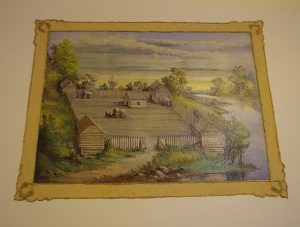
History tells us the beginning of our county was a struggle. During the early 1800s, county officials rotated among various churches and rented rooms throughout town to conduct business. Imagine trying to hold court in a different building every session!
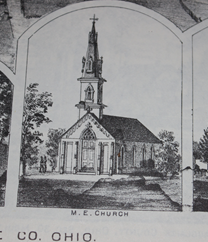
1880 Atlas of Auglaize County
This Gothic Revival structure replaced the original 1834 frame church.
As recorded in the 1880 Atlas of Auglaize County, between 1847 and 1850 the Methodist Episcopal Church housed both school and county governments – a testament to how our pioneers made do with limited resources – a genuine all-purpose community building!
Before the first permanent courthouse was built, county commissioners rented the Methodist building from James Elliott to hold court sessions. The rental agreement allowed for up to $50 to be spent adding seating and constructing a pulpit or judge’s stand for courtroom use.
The Methodist Episcopal Church, built in 1834 as a frame structure, was one of those impressive buildings well suitable for court proceedings. The arrangement was ingenious: county officials gained a meeting place, and in exchange, the congregation received a free pulpit.
The Methodist congregation continued using their original frame building for worship until constructing a new Gothic Revival church in 1861 (shown in the 1880 atlas). By 1850, plans were underway for construction of the county’s first permanent courthouse, which was completed in 1854.
Coordinator’s Note: As far as can be determined, no known photographs of the original 1834 Methodist Episcopal Church frame building exist. The church shown in the 1880 Atlas is the Gothic Revival replacement built in the early 1860s, after the congregation no longer needed to share their building with county government. The simple frame structure that served as interim courthouse from 1847-1854 had likely been demolished or repurposed by the time county atlases began including building illustrations.
If you know of any images or descriptions of the original 1834 church building, please contact the county coordinator.
The First Official Courthouse 1854 – 1894
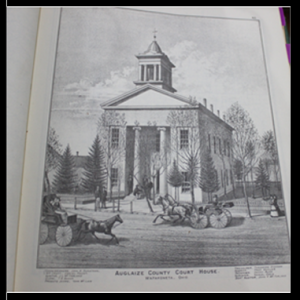
Plans were started and designed in 1850 for the first permanent courthouse that would be finally constructed by 1854, at a cost of $11,499. This was a lot of money in the 1800s and was probably viewed by the frugal citizens at the time, as a luxury far beyond its necessity. The courthouse would be located on South Blackhoof Street, occupying 3 lots. The commissioners at that time were Shadrack Montgomery, Hugh T. Rinehart, and John Morris. They awarded the contract to builders James Elliott and Sabert Scott for the construction.
| Left Corner | Right Corner |
|---|---|
| Commissioners: John H. Dunathan Wm Craft Daniel Focht Auditor: J.L. McFarland Clerk: T.B. Baker Probate Judge: John McLain |
Treasurer: Theodore Dickman
Sheriff: Fred Kohler Recorder: Henry Ruck Surveyor: Samuel Craig Dept. Auditor: John F. McFarland |
The design was Greek Revival style. All the classical symmetry with those two distinctive columns flanking the entrance and a cupola dome rising above. A rectangular drum rose above the roof which contained Corinthian column supports and was capped with a dome with a spire. The style was popular for public buildings in the mid-1800s, giving even modest county courthouses an air of dignity and permanence. This courthouse served the people of Auglaize County for decades.
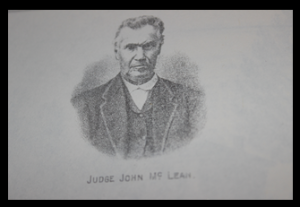
Judge John McLean served Auglaize County with distinction in two judicial roles. He first served as Associate Judge from 1860-1864, then returned to the bench as Probate Judge from 1875-1880. His portrait, featured in the 1880 Atlas of Auglaize County, reflects the respect he earned during his years of service.
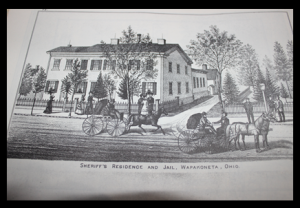
Sheriff’s Residence and Jail, Wapakoneta, Ohio
Sheriff John Clark (1854-1857) was the first to occupy the residence
1880 Atlas of Auglaize County, Ohio, pages 63 & 77
Building the New Courthouse, 1893-1894
When the original courthouse opened in 1854, it served a population of just over 11,000. That number had more than doubled to 25,444 residents by 1880. The county was thriving – more farms, more businesses, more families needing services. The Greek Revival courthouse simply couldn’t keep pace with that kind of growth. It was time for something bigger — and this time, they built to last; this would be the “new” permanent courthouse.
So on July 2, 1893, they started digging. This time they bought an entire city block – bounded by Willipie, Pearl, Perry and Mechanic Street and hired 85 men at $1.50 a day to build something that could handle a thriving county.
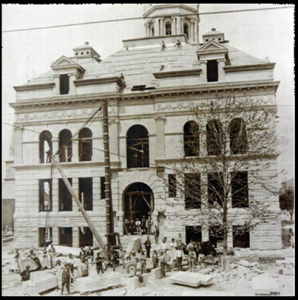
The original budget was around $102,000, but as the work progressed, additions and alterations kept adding up. By the time commissioners took possession in December 1894, the total cost hit $259,481 – including the land, construction, furnishings, and that beautiful power plant with its stone chimney.
When completed, the old courthouse was demolished. The project brought together architects Kremer & Hart with contractor E.M. Campfield – builders later recognized as some of the country’s most notable architects who helped create Auglaize County’s historic places. Note: The courthouse was added to the National Register of Historic Places on May 7, 1973.
Many civic buildings at the time, including the courthouse, were susceptible to fire. The engineers solved this problem with construction of a separate powerhouse.
The Powerhouse
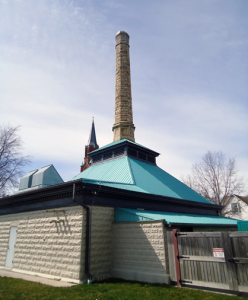
Boilers for heating and power generators that were a significant cause of fire at the time, were in a separate powerhouse. Steam-driven dynamos produced electricity that, along with steam for heating and hot water, were fed to the building via an underground conduit.
The solution is what we see today: a small building done up in the same Berea sandstone that features a pyramidal roof and central chimney that rises thirty feet in the air, to hold the electric dynamos used to light the courthouse.
This was ingenious idea! The tower is a work of art that blended in with the landscape of the courthouse. This was the workhorse powerhouse of the day and heated the entire courthouse through Ohio winters for over a century.
Inside the courthouse
In some ways the interior of the courthouse is even more impressive than its exterior. With its tile floors, marbleized columns, banisters, wainscoting, and skylights of stained glass, the building feels both grand and intimate at the same time. Colorful murals showing scenes like The Pioneers and America 1928 are featured throughout the interior. These murals reflect the spirit of early American settlement and the frontier experience. They are displayed prominently within the courthouse offering visitors a glimpse into the region’s historical narrative.

Ms. Justice and the Clocktower – Spire
Ms. Justice is particularly cool; she originally stood facing east when installed in 1894 at the building’s peak spire. History tells us that the community of St. Marys found this offensive, as they had the back of Justice toward them. So they raised money to have her turned to the north.
But by the 1950s the statue was removed due to deterioration and safety reasons. The only parts salvaged from the original Justice were the head, right hand, and sword.
However, in 1994, Lady Justice was saved and restored in time for the centennial of the courthouse. The Auglaize County Historical Society raised money to restore her through a project called “Copper Pennies for a Copper Lady,” which raised over $25,000.
On July 7, 1994, the community gathered to celebrate the courthouse’s 100th anniversary with an event called “Moonwalk ’94,” a nod to the 25th anniversary of Neil Armstrong’s first steps on the moon. It was a fitting tribute from a county proud of both its history and its place in the world.
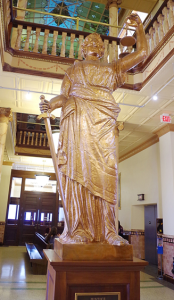
The second floor is the main floor where you will find Ms. Justice now firmly located on a pedestal, facing north. The pedestal contains a time capsule to be opened in 2094, with various items inside, one item being the names of the donors for the restoration of the statue.
The Clocktower
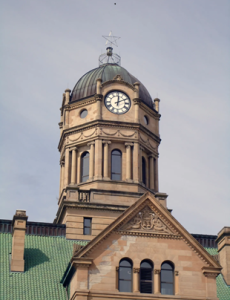
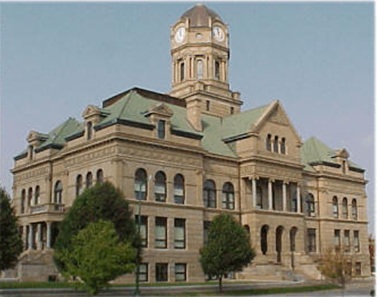
This is the clock tower where Lady Justice once stood. It’s estimated to be over 175 feet tall! Just imagine Lady Justice on top of that, no wonder it has been said you could see the tower from Rt. 33 highway. In the courthouse picture shown here you can see Lady Justice on the tower!
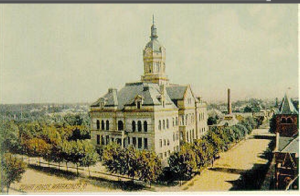
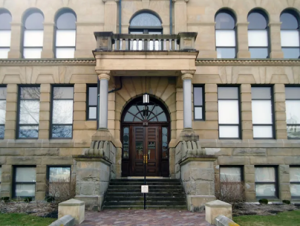
There’s a mystery behind those beautiful windows above the courthouse doors. During this time, air conditioners or HVAC units were unheard of. Yet buildings – both private residences and public – needed air circulation to achieve cooling. Enter the ‘transom’ window, a unique design with a cross-bar or beam framing the top of the door.
The windows sat above the door with a handle-type crank that allowed the window to tilt upwards or outwards for air circulation. Since we know heat rises, this invention let hot air escape through the transom window, creating a natural ventilation system. In our courthouse’s case, the windows were arched and made of stained glass, which I’m sure required a special mechanism to operate. Today, most people only see the beautiful window above the door without realizing its original purpose: a ventilation system before modern air conditioning.
Courthouse renovation – 2011 – 2012
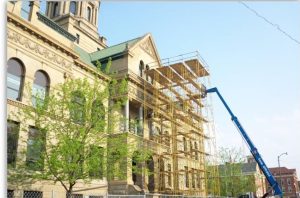
The remodeling and renovation of the current courthouse arose again because of the county’s growth. The 130 year building needed to be brought into the 21st century in more ways than one.
During the 2011–2012 renovation, county offices were temporarily relocated to nearby buildings in Wapakoneta, including rented spaces and other county-owned facilities. The courthouse itself was vacated for nearly two years while the massive project was underway.
Wait this sounds familiar….Remember how our county courthouse first started? The court offices shared and rented space in the Methodist Episcopal Church in 1834 until the need for the first courthouse built in 1854. History seems to have repeated itself with the remodel and renovation of the 2011-2012 courthouse.
The extensive renovation involved both preserving historical character and updating essential infrastructure. Delicate cleaning of decorative trim and frescoes was carefully undertaken, while walls were painted in earth tones to enhance the building’s historic charm.
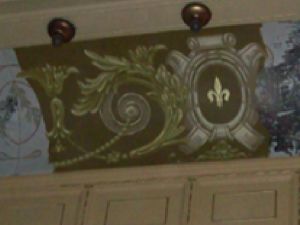
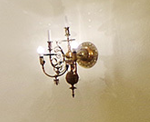
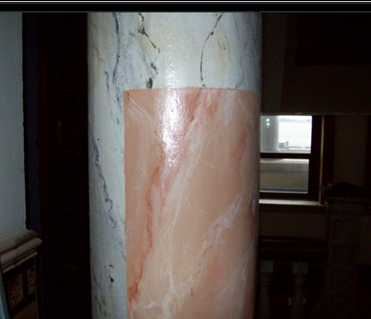
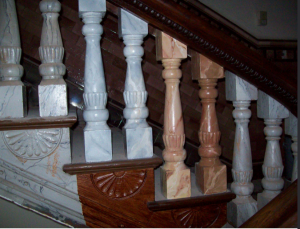
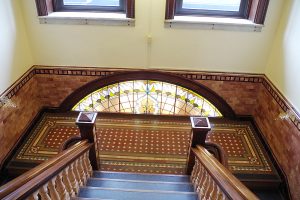
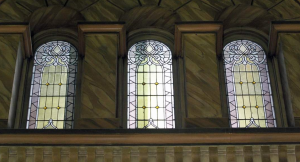
Behind the scenes, the real work of modernization was taking place: completely updated electrical systems, installation of high-speed internet capabilities, security camera networks systems.
The courts received new technological equipment to improve efficiency, while expanded office spaces were carved out to meet current needs and in addition adding two new floors to the building. Plumbing systems that had served the building for decades were repaired and upgraded to modern standards.
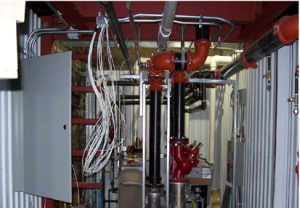
The Hidden Source Behind It All!
Not to be forgotten – and perhaps most critical of all – was the extensive renovation of the powerhouse, the true heart of the courthouse complex. This architectural marvel, designed by Kremer & Hart as an ingenious fire-safety solution in 1894, has quietly powered the courthouse through more than 130 Ohio winters.
While visitors admire the courthouse’s impressive facade and elegant interior, few realize that the building’s very functionality depends on this separate stone structure and its network of underground conduits.
The powerhouse renovation required margin-top: 1em;meticulous coordination – updating 21st-century HVAC systems while preserving the integrity of the original design. Extensive trenching work upgraded the underground infrastructure that carries heat, power, and climate control from the powerhouse to every corner of the courthouse.
This behind-the-scenes engineering feat ensures that the same ingenious system that impressed visitors in 1894 will continue serving the building for another century.
Enter the year 2019 and the Courthouse is now 125 years old!
Time for a celebration!
On Sunday, February 10, 2019 a birthday celebration of 125 years was held in honor of the building’s long history and its recent restoration. The event was organized by the Auglaize County Historical Society. Rachel Barber, the Historical Society’s Administrator, welcomed residents into the courthouse for tours, refreshments, and programs. The anniversary celebration highlighted both its long history and the community’s commitment to preserving it. Originally completed in 1894, the courthouse remains a central symbol of Auglaize County’s civic life.
Governor Mike DeWine and his wife, Fran, attended the ceremony and gave the commemorative program held in one of the courtrooms. Governor DeWine described courthouses as the “heart and soul” of their counties—places where justice is carried out and where communities have traditionally gathered. He praised Auglaize County for preserving what he called a “magnificent building.”
Historical Society administrator Rachel Barber tied the celebration’s theme, “Auglaize County Reaches for the Stars,” to the upcoming Apollo 11 anniversary. She also noted that the celebration reflected the community’s affection for both the county and its landmark courthouse.
Auglaize County Celebrates Its History 2019 – 2023
On April 20, 2023 Auglaize County celebrated its 175th anniversary with an open house held at the Courthouse. The Anniversary Committee helped bring the day together, reminding everyone how far the county has come since the pioneers built the first modest courthouse of 1854.
The important event was hosted by several county officials including Judges Frederick Pepple and R. Andrew Augsberger, along with representatives from Domestic Relations, the Clerk of Courts, the Prosecutor’s Office, and the Public Defender’s Office. They guided visitors through courtrooms and offices that are rarely seen by the public, reminiscing with their own stories and memories of the building’s history and their part in recent years.
The Committee also welcomed former NASA astronaut Dr. Don Thomas as part of the 2023 Summer Moon Festival, emphasizing how the courthouse continues to serve as a community landmark.
Committee members, Rachel Barber, Rollin and Kay Wellington highlighted the courthouse’s 1893–94 construction. Its Berea sandstone exterior, and the many original architectural details that are still apparent even after the 2012 renovation. The building’s structure and character are still very much intact.
Rachel Barber mentioned it is her belief that the courthouse reflects the county’s strength, beauty, and longevity — a structure that has outlasted its builders and continues to anchor our community as we move into the future.
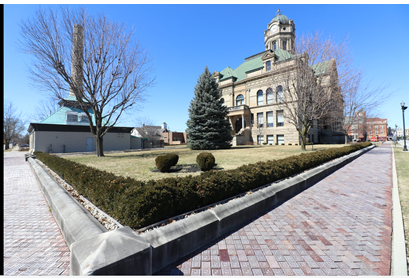
When you walk up to the courthouse, one of the first things you notice is the stone. Berea sandstone — native to Ohio — massive, ornate, and beautiful even if you don’t know its name or origin. The building itself is Richardsonian Romanesque, a style that flourished in the late 1800s and early 1900s.
For five years I climbed the courthouse steps, worn smooth in the middle from footsteps of people whose lives became intertwined with the courthouse through the years. I’d look up at the archways, amazed at the carving, the precision, the way each stone fit so deliberately into the next. There is just something about a building that has stood for more than 130 years — you feel the weight of all the lives that moved through it.
I often wondered what the founding pioneers would think if they could see what their efforts became. What would they say about this grand building that has outlasted them by generations? The cornerstone says 1893…
“Imagine them chattering among themselves about what they accomplished: ‘Remember when we had to share space in the Methodist Episcopal Church? Then we built our own courthouse – by ourselves! But it got too small, so we had to tear it down and start over, again! And now look what we’ve got – this grand building that’s been standing strong for over 130 years!” A job well done.”
|
|
As the courthouse continues to serve the people of the county it is more than just a building – it’s a cherished historic landmark. It honors the pioneers whose determination shaped our county and made the courthouse possible.
Do you have photos, documents, or memories of the Auglaize County Courthouse to share? Contact the county coordinator.